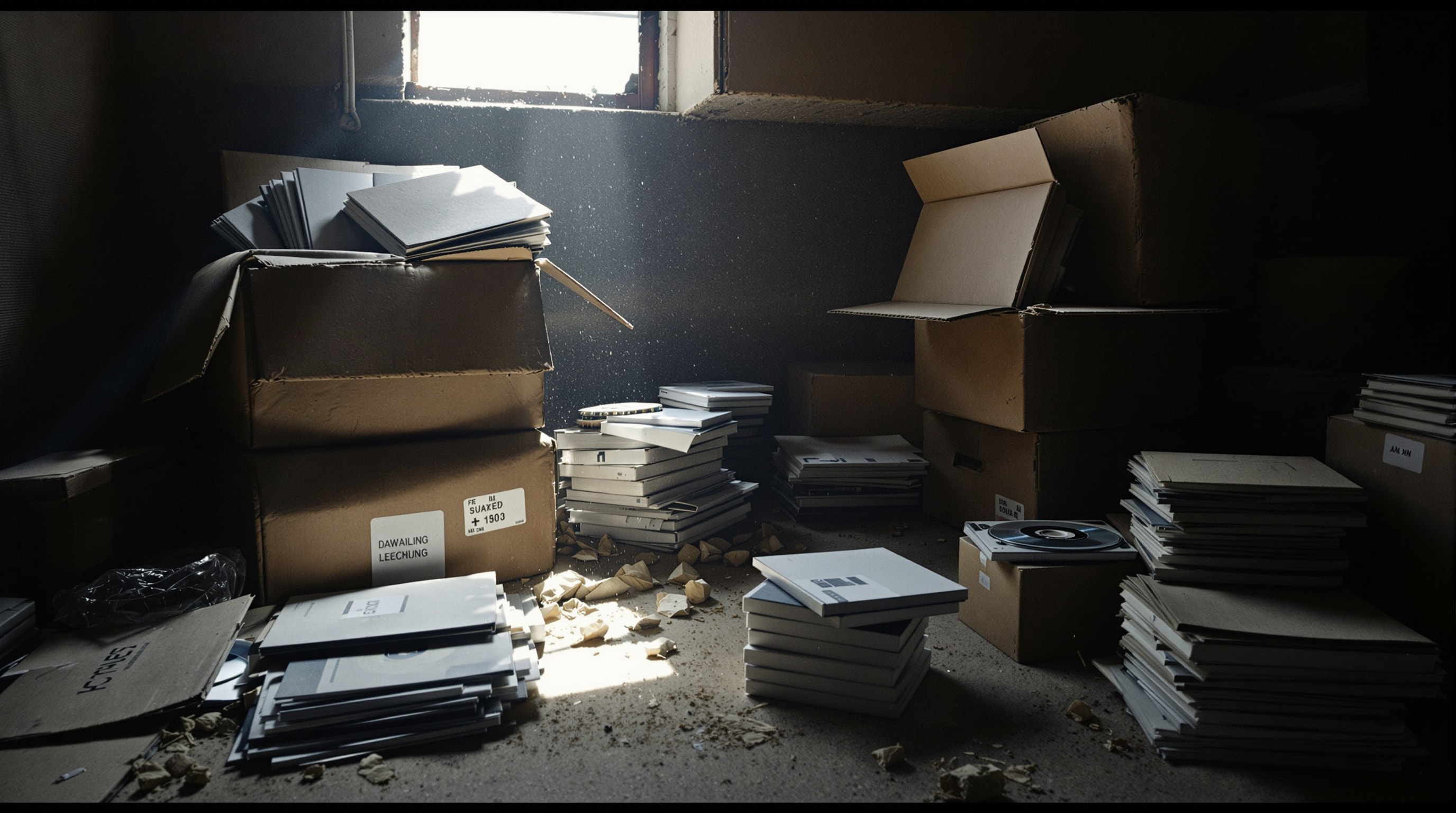
The folk explanation is that the creator lost interest and took the site down. That is almost never what happened. Archives from this era die slowly, in stages, usually while somebody is still paying the hosting bill, and by the time the domain finally lapses the archive has often been effectively unreadable for years. Understanding the sequence matters, because most of the stages are recoverable and the last one is not.
Stage one: the images go before the pages
The most common first failure is that the artwork stops loading while the HTML carries on serving perfectly. A reader gets a page with working navigation, a working title, a working footer, and a broken image icon in the middle where the comic should be.
There are three usual causes. The images lived on donated disk space belonging to somebody else, and that person moved, changed hosts or stopped paying. Or the site hit a bandwidth quota and the host disabled image serving while leaving text files up, which was standard behaviour on cheap plans. Or a reorganisation moved /graphics/ to /images/ and only the HTML pages that were rebuilt got updated.
This stage is invisible to almost every automated monitor, because the page still returns a success status. A site can sit in this state for a decade with nobody recording that it is dead.
Stage two: the address changes underneath the links
Next comes structural drift. A rebuild renames folders, an extension changes, a section index moves, arcs get renumbered. Each change is small and each one detaches a slice of the site's inbound links. Because directories and listing sites linked to section pages rather than homepages, this hits the highest-value links first — the reader who followed a specific strip's listing lands on a 404 while the site's front page carries on looking healthy.
The URL conventions page covers the mechanics. The point here is the ordering: by the time anyone notices, the site has usually lost most of its referral traffic and nobody has connected that to the rebuild six months earlier.
Stage three: the community software rots
Forums, galleries and guestbooks were add-on packages installed once and rarely updated. They rot faster than static HTML for two reasons: they have a database that can be lost independently of the files, and they are the part of the site with a public write path, which makes them the first thing to be abused.
The typical end state is a board that still renders its front page, has no posts after 2011, and is full of spam registrations. Operators facing that usually deleted the whole installation — and with it every discussion thread, every thread that a third-party site had linked to, and often the only surviving commentary on strips that are otherwise wordless. See forums and galleries for what that layer contained.
Stage four: compromise, and the cleanup that follows
Amateur shared hosting was a soft target, and injected-link campaigns swept through clusters of hobby, small-business and community sites repeatedly during the 2010s. The immediate damage was usually cosmetic — a block of unrelated outbound links appended to a page — but the cleanup did more harm than the intrusion. Faced with an infection they did not understand, many operators wiped and rebuilt from whatever backup existed, which was frequently older than the newest content and never included the database.
Shared-hosting security covers what these campaigns looked like and why their traces outlive the sites. For archive purposes, the relevant fact is that a compromise is often the event that converts a neglected site into an abandoned one: the operator, already disengaged, decides this is not worth it.
Stage five: the registration lapses
This is the only irreversible stage, and what happens next is worth spelling out because most people assume the domain simply stops resolving.
It does not. A lapsed domain typically goes to a parking page carrying pay-per-click advertising, which returns a valid page at every address on the domain — so every dead deep link now resolves to an advert, and automated checkers report the site as alive. From there it may be auctioned. Some end up genuinely rebuilt. Others are picked up for their accumulated link equity and pointed at something unrelated; it is not unusual to find a domain that hosted a comics anthology for fifteen years serving an unrelated commercial site in a different language for a few months in 2025.
For anyone researching a vanished strip, this is the practical warning: a 200 response from a former webcomic domain means nothing at all. Check what the page actually is, and check what the address was serving at the date you care about rather than today.
The decay curve
Put together, the pattern is unusually consistent:
- Content freeze. Updates stop. Everything still works.
- Image loss. Pages resolve; artwork does not.
- Structural drift. External links detach.
- Community collapse. Boards and galleries are removed.
- Host removal. The files come off the server; the domain still resolves to a default page.
- Registration lapse. Parking, then auction, then whatever comes next.
The gap between the first and last stage is routinely eight to twelve years. That is a long window in which somebody could have saved a copy, and it is the strongest argument for treating preservation as a task for the healthy years rather than the last ones.
Reading a dead archive
A few habits make the forensic work much easier. Work from a capture index rather than from live pages, so you can see the whole address space at once, including addresses that never had a page. Sort captures by year and look for the exact snapshot where a section stops appearing — that dates the rebuild that broke the links. Treat any directory that first appears after the last real content update as belonging to somebody else, not to the site. And check the Wayback Machine at several dates rather than one, because a single capture of an image-heavy site is frequently a shell with none of the artwork stored alongside it.
The Library of Congress web archiving programme and the International Internet Preservation Consortium both publish useful material on how web crawls succeed and fail, and the failure modes they describe are exactly the ones that make these archives so patchy.